An engine that recognises an individual wild animal from a single photograph, turning every visitor with a phone into a sensor for conservation.
About 140,000 giraffe remain, up from under 100,000 in 2016, first because the data improved, and now because conservation is genuinely working: three of the four species are increasing. The longer story is the range itself, nearly 90% of it already gone.
Where protection is funded, tracked and acted on, giraffe recover, that's the lesson of the last decade. The ones still slipping away are the ones we cannot yet see clearly. The difference is data, and that's exactly what Patterns produces.
Kruger National Park alone holds ~12,412 giraffe (range 10,345 to 14,554), the largest single protected population. Sources: GCF State of Giraffe 2025; African Journal of Wildlife Research 2025.
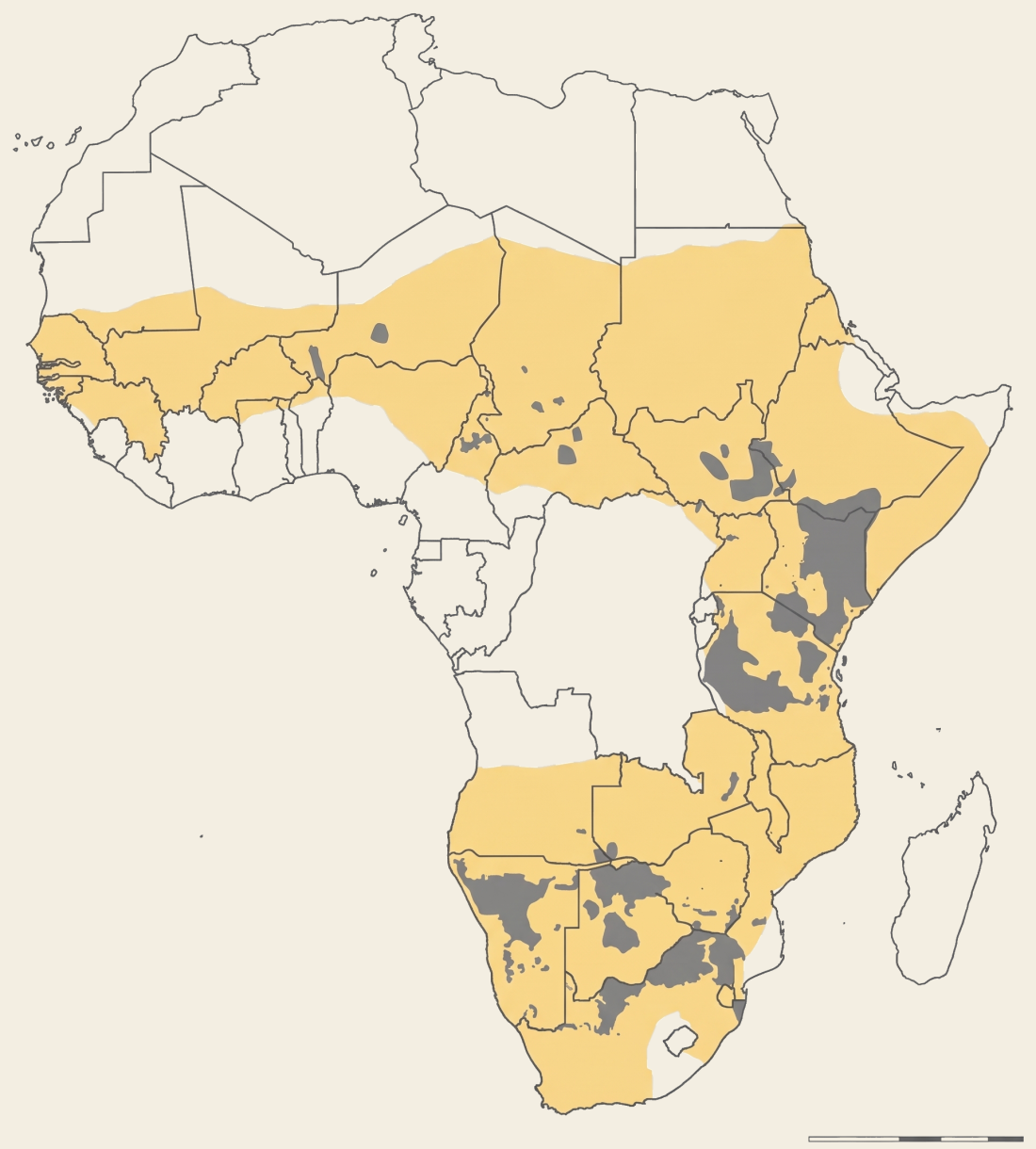
Historic range vs current populations · Source: IUCN / GCF
The gold range is where giraffe once had room to move. The grey is where populations remain today, smaller and separated, hard to read from occasional surveys alone.
Every photo runs a multi-stage computer-vision pipeline: instance segmentation isolates the animal, the coat is lifted into hundreds of scale-invariant keypoints and encoded as high-dimensional descriptors, matched against tens of thousands of references with approximate-nearest-neighbour vector search, then confirmed by geometric, ratio-tested verification and a calibrated confidence score.
Detection and matching run as cloud inference workers against a warm, in-memory vector index; the catalogue is the source of truth and sharpens with every verified sighting. The methodology builds on the field's gold-standard work, Microsoft's AI for Earth wildlife re-identification and the Wildbook research network, advanced into a real-time engine and tuned on live African field photography, built to a standard that makes rebuilding it pointless.
A real coat-match from the engine. Every line is one keypoint matched to a known individual.
What looks like a photo app is a multi-stage computer-vision pipeline, a continuously-learning catalogue, a data-integrity backbone and an engagement system, each a serious project in its own right. That is the hard part, and it is already built and live.
Building the engine took years. The next mountain is reach, getting Patterns into the hands of enough citizen scientists to feed it. That's exactly where the right partners come in.
The app is the cheapest data-collection sensor network and the most shareable conservation story in the category. The value is the structured, individually-identified sightings it produces, the data parks and researchers have never had.
Every serious wildlife-ID effort, from Happywhale to Wildbook, exists to serve conservation, not to sell downloads. Patterns is the same: the app is the means, the species is the point.
Most safari apps end at the gate. Patterns is just getting started. The giraffe you meet today becomes yours to follow, long after you've driven home.
One sighting becomes a lifelong thread: the giraffe, the guest and the park, all on the same map.
Every verified sighting, location and movement track is handed to giraffe conservation, parks and reserves, free of charge. No paywall on the science. That's the whole point.
Researchers already prove a giraffe can be identified by its coat: GiraffeSpotter and Wildbook, backed by the Giraffe Conservation Foundation. That part works.
A consumer-grade app that turns anyone with a phone into a giraffe spotter, with the joy that keeps them coming back and the data pipeline conservation actually needs. It's built, and it's live.
Detection, coat-mapping, the live match index and the signed-photo pipeline are built, deployed and running today, identifying real giraffe from a single photo.
The engine, the app and the data pipeline are live on iOS and Android. The hard part is done.
A polished, conservation-grade product, ready for real giraffe, real parks, real guests.
Get it into the hands of the people who will love using it, and whose sightings power the data.
Patterns is, first and foremost, about protecting wildlife and getting the next generation to fall in love with the bush and the creatures in it.
Commercial branding has its place. But the goals that come first are driving usage and knowledge, and protecting the beauty of nature, and those are the goals we'll share with any partner who joins us.
We built the solution. Help us get it into the field, and let's save giraffes together.
Numbers and sources, and the caveats.
Giraffe ~140,000, down ~40% in 30 yrs, 90% habitat lost · Giraffe Conservation Foundation.
By species: Southern ~69k, Masai ~44k, Reticulated ~21k, Northern ~5.9k · GCF State of Giraffe 2025.
Southern giraffe up ~50% in five years · GCF State of Giraffe 2025.
Kruger ~12,412 giraffe (10,345 to 14,554) · African Journal of Wildlife Research 2025.
West African giraffe 49 (1996) to ~600 today · GCF / Operation Sahel.
Numbers revised up from <100,000 (2016) as data improved · GCF.
Wild Me / Wildbook: nonprofit, 8 staff, 53 species · Wild Me, National Wildlife Federation.
GiraffeSpotter / Wildbook for Giraffe · Giraffe Conservation Foundation, giraffespotter.org.
Computer-vision approach · Microsoft AI for Earth, Wildbook / Wild Me.
Citizen science at scale · eBird (Cornell Lab), iNaturalist, Happywhale.
Note: population figures are best-available estimates from GCF and peer-reviewed assessments; ranges are given where published. Full links in the companion memo, business-case-response.md.